
If you’ve worked on GenAI systems, you probably know POC Purgatory—that frustrating limbo where a flashy demo never matures into a production-grade product.
As the O’Reilly piece on Evaluation-Driven Development reminds us, the fix was clear: test, evaluate, iterate.
But as we move from simple LLM apps to autonomous AI agents, a new kind of purgatory is emerging.
And this one isn’t about effectiveness.
It’s about Agent security.
The “Lethal Trifecta” of AI Agents
As Korny Sietsma puts it in Martin Fowler’s blog, AI agents are a Lethal Trifecta of risk because they:
- Access sensitive data (files, databases, APIs)
- Consume untrusted content (prompts, web pages, emails)
- Trigger external actions (send emails, post to the web, execute code)
It’s the perfect storm.
Your demo works beautifully — until one clever prompt turns your helpful assistant into an unintentional internal attacker.
This is not a purgatory we can escape with better evals.
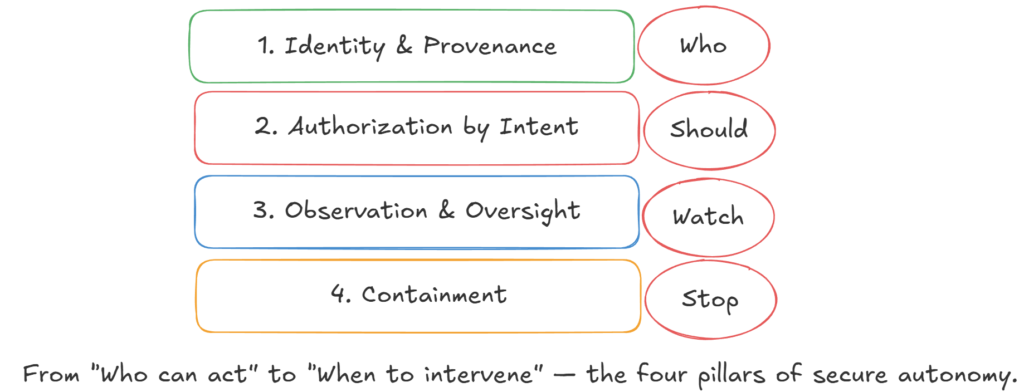
We need a mindset shift: Authorization-Driven Design.
The Shift: From Evaluation-Driven to Authorization-Driven
Agent Security can’t be the final checkbox before deployment; it must be the first architectural question.
As LangChain’s explainer on Agent Authorization notes, agents have fluid access needs that don’t fit traditional app security.
They don’t just “call APIs” — they decide when and why to call them.
That means we can’t treat agents as a single, monolithic identity.
We must design contextual identities — where how the agent acts depends on who it’s acting for.
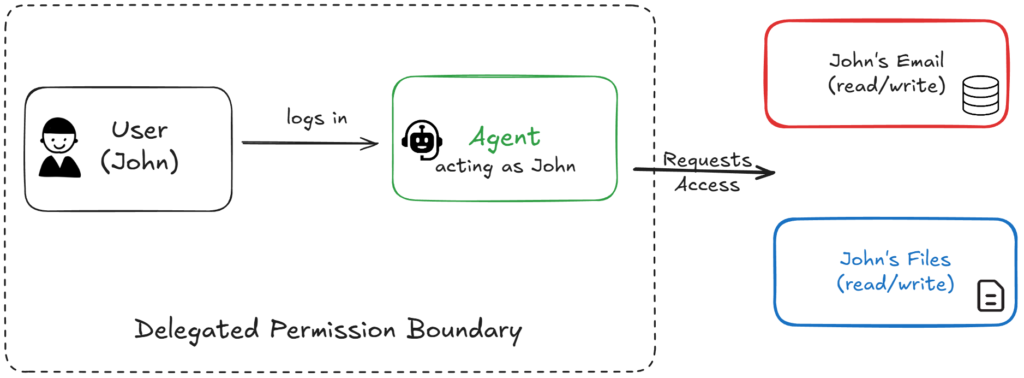
Pattern 1: Delegated Access (The Agent as Your Proxy)
When: The agent acts on behalf of a user.
Example:
“Can you summarize my recent emails and send a draft to my manager?”
Principle:
The agent should inherit only the user’s permissions.
If the user can’t access a confidential document, the agent shouldn’t either.
Implementation:
Use patterns like OAuth 2.0’s Auth Code Flow or On-Behalf-Of Token Flow — delegating authority safely, for a limited scope.
Pattern 2: Direct Access (The Agent as an Autonomous Worker)
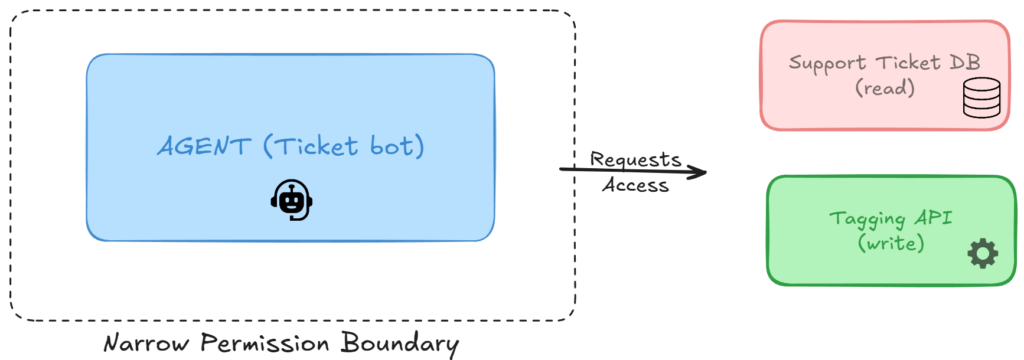
When: The agent operates independently – say, scanning tickets or monitoring logs.
Example:
“Can you tag P0 issues in new support tickets automatically?”
Principle:
Give the agent its own service identity with the least privilege possible.
It reads tickets and adds tags — nothing else. Implementation:
Use Client Credentials Flow. The agent authenticates as itself, not as a human, with tightly scoped access.
Why This Breaks the Trifecta
- Delegated Access limits exposure to each user’s data.
- Direct Access confines autonomous agents to minimal, predefined domains.
Together, they dismantle the “Lethal Trifecta” — not by locking agents down, but by teaching them who they are allowed to be.
The Way Forward
The next POC purgatory won’t come from flaky evals — it’ll come from insecure autonomy.
If we don’t design who can do what from day one, we’re not building intelligent systems. We’re just building faster pathways to chaos.
The future of agentic AI isn’t about more capable models — it’s about trusted autonomy.
Authorization isn’t red tape.
It’s how we make freedom safe.
#AIAgents #AISecurity #AgenticAI #LLMSecurity #Authorization #ZeroTrust #ResponsibleAI #Cybersecurity